Building date: 1844, demolished
Original use:
Corner structures:
Mortar application and content:
Types and uses of stones:
Types and choice of windows:
Structures with similar masonry details:
Masons who worked on building: Alonzo Bradley
Unique features:
Map views courtesy Google Maps. Address is Google Earth confirmed; 43°10'17.45"N 77°33'35.67"W.
Town of Irondequoit and Monroe County Maps
Rochester Democrat & Chronicle, June 21, 1913
Puzzle Found in Clause of Deed
Says Land Must Be Used for School PurposesBuilding a Real Landmark
In a Few Instances Three Generations of Families Received Their Early Training in Cobblestone House That Soon Will Be Razed
When John McGonegal, on June 1, 1844, sold to the town of Irondequoit the site for the cobblestone schoolhouse that now stands, unoccupied and idle. opposite the end of Bay street, he did not foresee the development that years would bring to that section. It was a rural community, and the city limits were two miles away. If he had known perhaps he would not have inserted a provision in the deed to the school district trustees that has prevented any transfer of the land up to this time. "Provided," says the deed, "that said land shall be always kept and used for the purpose of a school and a school-house shall be always kept on said land."
The original school in that district stood at the corner of Merchants and Culver road, on the site of the present Costick house. It was a wooden structure, and along in 1843 it became evident that a new building was necessary. The school trustees were farsighted enough to see that the corner would in time be a center of activity and they wanted the school kept in the immediate vicinity. So they purchased the site opposite the end of Bay street, and moved part of the old school to it. They erected the cobblestone building without delay, and it was occupied by the first pupils in the fall of 1844 or the winter of the same year.
Cracked, but Serviceable
Three generations have attended school in the building, which is cracked and scarred why time and fire, but still standing as serviceable as ever. The cobblestones are in rows, with about forty-two rows between the foundation and the top of the side walls. In the south wall is a crack that developed many years ago and was repaired, while the front was scarred by the fire that occurred in the building several months ago. Because the building is not in use, the scars remain.
Among the pupils in the early days were Henry B. McGonegal, who was later a member of the Board of Supervisors for several years, and George E. McGonegal, who was elected to the Assembly. After his service in Albany he was elected superintendent of the poor, and retained the office longer than any other man that has held the place in recent years.
Then there was Chisholm Smiles, who differed from the McGonegal boys in that he was denominated by the spirit of the nomad, and after he was graduated from the cobblestone school-house, turned towards the setting sun, crossed the plains in the Indian days and eventually became a resident of Nevada and California, according to the recollections of those who knew him, and attained fame as a civil engineer.
Another early pupil was Winfield Wood, who also became a supervisor. He was a member of one of the few families that have been represented in the school by three generations. His daughter, Winifred Wood, attended school there, and afterward married Henry Schenck, who was a pupil with her, and their daughter, Janet Schenck, was the representative of the third generation that studied there.
Three Generations of Pardees
Another family represented by three generations in the school was that of Edward Pardee. He was the first of the family to enter the cobblestone school as a pupil, and in the course of time was followed by his three sons, Hiram, Charles and Herbert Pardee, The third generation was represented by Edna Pardee, daughter of Charles Pardee.
Among the girl pupils in the old school in the early days were Mary E. Smiles, Jeannette Smiles and Anna Smiles, sisters. They were not related to Chisholm Smiles, so far as known. Mary E. Smiles married Henry B. McGonegal and Anna Smiles married Winfield Wood, so that, in those families, both husband and wife saw their children and grandchildren to to the school in which they themselves had been pupils. Among the Waring children, Mary, who did not marry, and Hattie, who became Mrs. Chipman, of Began, and Isaac and Elias Waring.
At the time the site of the school was purchased it was the seventh district of Irondequoit. Later it became the sixth and is now the first district. The original district remained practically unchanged until 1875, by which time Rochester, as a city, had "got into its stride," and, reached out, absorbed the country to the center line of Culver road, thus lopping off a considerable area formerly tributary to the school. But the population thus cut off was made by new settlers in Irondequoit, so that with a slight rearrangement of boundaries, the district remained about as large, in number of children, as ever.
Growth of Population
The population continued to grow, and three or four years ago a new impetus was given by the opening of the Rogers farm. People began to say the district had outgrown the cobblestone building where their fathers and grandfathers had attended school, and last year the new building on Clifford Avenue was opened. The impetus given to the neighborhood three or four years ago has now been increased by the opening up of the Culver road tract, directly opposite the old school. This has again brought up the question of disposing of the school and its site.
When the matter first came up nothing was known of the provision deed, but it is believed that the obstacle can be surmounted. They say if all of the heirs of John McGonegal, who inserted the provision, will consent to the sale of the property, permission to sell will be granted upon application to the proper court. The matter has been under discussion for some time, but no line of action has been decided upon. Richard Palmer blog.
Rochester Democrat & Chronicle, June 5, 1915
The old cobblestone school house in Culver Road near Bay Street is being razed to make room for the extension of Bay Street to Spencer Road. The building had been erected in 1844 to serve children in the Town of Boyle. Richard Palmer blog.
A View from the Past, A Vision for the Future, by Susan Zande, Editor, 1989, Irondequoit Press - Wolfe Publications, Town of Irondequoit, New York. Souvenir booklet commemorating the celebration of the Town of Irondequoit's 150th Anniversary in 1989. Selected cobblestone structure pages. Pages are not numbered. In the section "Our Early Schools" there is a brief mention "1n 1828, a frame building was erected...replaced by the Cobblestone School, built opposite Bay Street, on Culver Rd."
- "Cobblestone Architecture", 1944, Carl Schmidt: Name reference, Irondequoit District School
- Page 37
- "Cobblestone Masonry", 1966, Carl Schmidt: Name reference, House
- Page 41
 1858 Monroe County Map Iro-4 Excerpt 161029_3N5A9102_21.jpg ¹ | 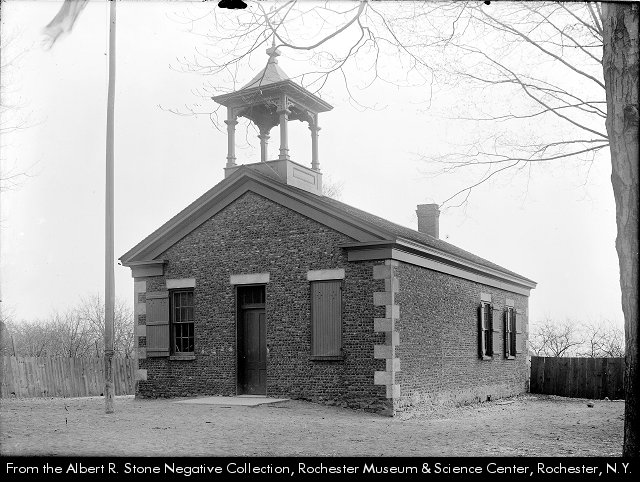 scm04777.jpg ² |  scm04778.jpg ² |
¹ 1858 Monroe County Map excerpt courtesy Emily L. Knapp Museum and Library of Local History. High resolution photography by Gregory Lawrence
² Image courtesy Richard Palmer. Attribution not provided. Downloadable image available From Monroe County Library System
